
The $182 Billion Question: What Three Decades of FERC Form 1 Data Say About Unitization Backlogs
Twenty years ago, Controllers and CAOs rarely raised their unitization backlog with me. In 2026, every customer I meet with wants to know what other customers are doing to address the backlog.
The processes are working, and the capital projects are earning rate base and tax recovery. Even so, the Account 106 balance (Completed Construction Not Classified, or CCNC) holds hidden opportunities and risks.
That gap often stays off the monthly CFO scorecard. When it does surface, the stories are significant: multi-million dollar swings in depreciation, delays in evaluating tax repairs classifications, or a growing stack of interrogatories and audit requests that are challenging to answer. And as records age, the documentation needed to resolve the backlog becomes harder to source.
A 30-year trend that is still accelerating
A PowerPlan analysis of FERC Form 1 filings from 1994 through 2025 shows Account 106 balances growing roughly 10x industry-wide, from about $16.8B to $182.3B. As a share of gross plant, the balance moved from roughly 3% to nearly 10% in this time period. Based on our conversations, this trend is not limited to just electric utilities, this is prevalent across all utility types.
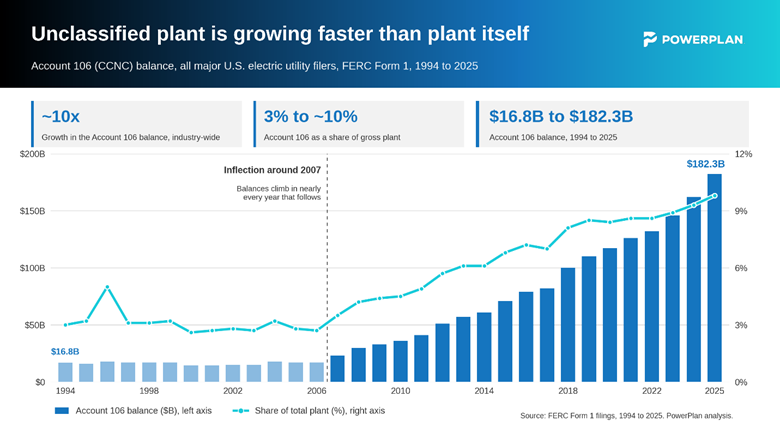
Fig. 1: Account 106 (CCNC) balance of U.S. electric utilities growing from $16.8B in 1994 to $182.3B in 2025, rising from about 3% to nearly 10% of gross plant.
The unitization backlog that started in 2007 continues to steadily climb
The shape of that curve matters more than the endpoints. Through the late 1990s and early 2000s, balances were flat to declining, hovering in the $15B and $19B for more than a decade. The inflection comes around 2007, and the balance has climbed in nearly every reporting year since.
Critically, the ratio roughly tripled alongside the dollars. If backlogs scaled only with capital spend, the percentage of gross plant would have held steady. It didn’t. Instead, unclassified plant is growing faster than plant itself, which points to a throughput constraint in the unitization process.
The mechanics are familiar to anyone who has worked a large work order or high-volume distribution work: every month millions of financial transactions in project and asset accounting need to be classified into thousands of unit level assets. Meanwhile, capital programs tied to grid modernization and load growth are expanding faster than accounting headcount, and the manual effort scales roughly in line with capex.
Regulators are putting unitization timing on the compliance clock
For years, unitization timing was an internal efficiency question. Regulators now treat it as a compliance question. In NCUC Docket G-9 Sub 837, the Public Staff found that less than 50% of Piedmont Natural Gas’s Account 106 balance had been unitized within 12 months. After multiple interrogatories and testimony, the company and staff negotiated a binding standard into the settlement: 90% of capital unitized within 12 months of its in-service date, with late capital losing return.
This standard starts in North Carolina, but as I’ve seen over the decades in the industry, these travel across the country quickly. What was once a modest timing and risk issue, now has the potential to directly impact both the top and bottom line.
Where this leaves finance teams
The tolerance for backlogs is shrinking while the balances grow. Utilities that can produce traceable support on demand will likely set the benchmark others are measured against.
Watch the short video below to learn how PowerPlan Intelligent Unitization address this. It automates the line-item work that has kept unitization a manual, capacity-constrained process, with a traceable audit trail behind each result.
Intelligent Unitization | PowerPlan
Want to learn more?
Watch our on-demand webinar to see how Intelligent Unitization can help your asset-intensive company manage your backlog.
At PowerPlan, we work with the largest utilities in North America and support their management of more than $4 trillion in regulated assets. What makes that scale significant is the integrity of the data underneath it. The PowerPlan NXT platform seamlessly carries each asset’s regulatory, accounting, and tax details forward without re-entry or re-mapping, so the integrity of the data is defensible before regulators and tax authorities. When terms change and cost allocations shift with them, that asset-level detail is what lets you turn the change into information the rates and regulatory group can actually use – in hours, not weeks. Start the conversation with us today.

Author
Jim Dahlby,
Chief Customer Officer